
Synonymes
- ALAT, alanine aminotransférase
- (S)GPT, (serum) glutamaat-pyruvaat transaminase
- EC 2.6.1.2
Physiologie
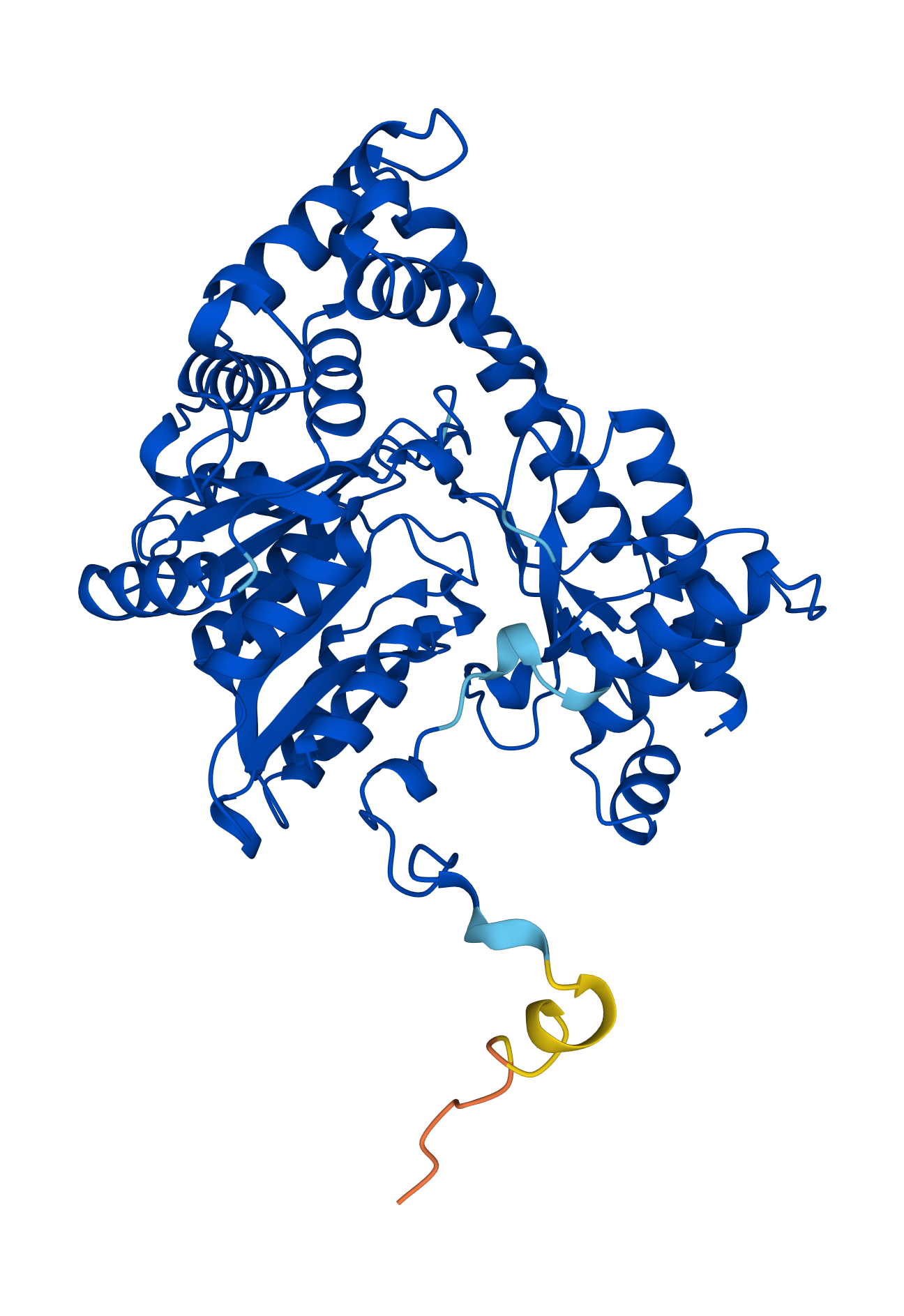
L’alanine aminotransférase catalyse le transfert du groupe alpha-amino de l’alanine à l’oxoglutarate avec production de pyruvate et de glutamate. L’ALT se retrouve principalement dans le cytoplasme (et seulement en petites quantités dans les mitochondries). Pour une activité optimale, comme l’AST, cet enzyme nécessite le cofacteur P5P.
Spécificité
- L’ALT est présent dans le tissu hépatique, musculaire (coeur et squelettique), rénale et les globules rouges.
- L’ALT est assez spécifique pour le foie chez le chien chat, furet, et primates. A un moindre degré chez le lapin et les rongeurs.
- Le tissu hépatique chez des grandes herbivores et porcine contient une activité enzymatique faible limitant l’utilité.
- L’ALT est peu spécifique pour le foie aviaire et reptilien.
Sensibilité
- Haute pour l’inflammation, la nécrose, la lipidose et le néoplasme primaire hépatique.
- Plus faible pour la congestion, le néoplasme métastique ou les anomalies vasculaires portosystémique.
Espèces et références
Bovin
5 - 18
U/L
Chat
<109
U/L
Chien
<117
U/L
Chèvre
<52
U/L
Dauphin
U/L
Furet
<120
U/L
Lapin
<70
U/L
Mouton
<44
U/L
Oiseau
U/L
Phoque
U/L
Porc
19 - 76
U/L
Reptile
U/L
Caractéristiques
Abbréviation
ALT
Catégorie
Foie-voies biliaires
LOINC
Méthode
UV with P5P - IFCC Ref. Proc., Calibrated
Délai
le même jour
Prélèvement
*
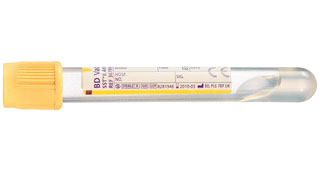
Sérum
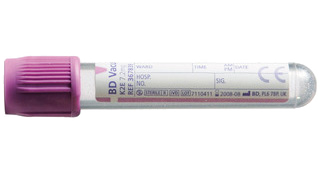
EDTA plasma
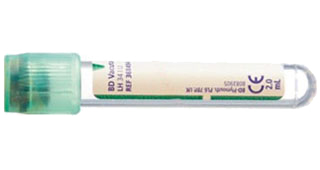
Li-Héparinisé plasma
* = préférence
Mis à jour le 10 octobre 2026 à 1h00
Références
1.
Valentine B, Blue J, Shelley S, Cooper B. Increased serum alanine aminotransferase activity associated with muscle necrosis in the dog. J Vet Intern Med. 1990;4(3):140-143. [PubMed]
2.
Swenson C, Graves T. Absence of liver specificity for canine alanine aminotransferase (ALT). Vet Clin Pathol. 1997;26(1):26-28. [PubMed]
3.
Sorensen K, Venn-Watson S, Ridgway S. Trace and non-trace elements in blood cells of bottlenose dolphins (Tursiops truncatus): variations with values from liver function indicators. J Wildl Dis. 2008;44(2):304-317. [PubMed]
4.
Venn-Watson S, Smith C, Jensen E. Assessment of increased serum aminotransferases in a managed Atlantic bottlenose dolphin (Tursiops truncatus) population. J Wildl Dis. 2008;44(2):318-330. [PubMed]
5.
Fauquier D, Mazet J, Gulland F, Spraker T, Christopher M. Distribution of tissue enzymes in three species of pinnipeds. J Zoo Wildl Med. 2008;39(1):1-5. [PubMed]
6.
Jerry Kaneko J, W. Harvey J, L. Bruss M. Clinical Biochemistry of Domestic Animals. Academic Press; 2008.
7.
Quesenberry K, W. Carpenter J. Ferrets, Rabbits and Rodents - E-Book. Elsevier Health Sciences; 2011.
8.
Montalvo V, Cruz M, Ahmad I, et al. Hepatitis E virus in bottlenose dolphins Tursiops truncatus. Dis Aquat Organ. 2017;123(1):13-18. [PubMed]
Récement sur pubmed
Chien
- Querengaesser, A, Iben, C, Leibetseder, J. Blood changes during training and racing in sled dogs. J Nutr. 1994;124 (12 Suppl):2760S-2764S. doi: 10.1093/jn/124.suppl_12.2760S. PubMed PMID:7996288 .
- Kelley, D, Lester, C, Shaw, S, de Laforcade, A, Webster, CR. Thromboelastographic Evaluation of Dogs with Acute Liver Disease. J Vet Intern Med. 2015;29 (4):1053-62. doi: 10.1111/jvim.13441. PubMed PMID:26179169 PubMed Central PMC4895357.
- Manzocchi, S, van Rooyen, LJ, Stock, G, Matlow, JR, Serra, M. Evaluation of A Novel Indirect Reference Interval Model for Canine Calcium and Alanine Aminotransferase. Vet Clin Pathol. 2025;54 (4):396-404. doi: 10.1111/vcp.70042. PubMed PMID:40990240 .
- Adams, J. Long-term clinical outcomes of healthy dogs with increased alanine aminotransferase. J Small Anim Pract. 2024;65 (12):857-866. doi: 10.1111/jsap.13777. PubMed PMID:39246001 .
- Chon, SK, Kim, NS. Evaluation of silymarin in the treatment on asymptomatic Giardia infections in dogs. Parasitol Res. 2005;97 (6):445-51. doi: 10.1007/s00436-005-1462-z. PubMed PMID:16151741 .
- Castonguay-Poirier, M, Fifle, L, Javard, R, Huvé, R. Long-term safety and efficacy of oral bezafibrate use in dogs with hypertriglyceridemia. J Vet Intern Med. 2026;40 (2):. doi: 10.1093/jvimsj/aalag041. PubMed PMID:41818730 PubMed Central PMC12981683.
- Schmidt, E, Schmidt, FW. Clinical enzymology. FEBS Lett. 1976;62 (SUPPL):E62-79. doi: 10.1016/0014-5793(76)80855-1. PubMed PMID:767140 .
- Badylak, SF, Dodds, WJ, Van Vleet, JF. Plasma coagulation factor abnormalities in dogs with naturally occurring hepatic disease. Am J Vet Res. 1983;44 (12):2336-40. . PubMed PMID:6660623 .
- Murakami, Y, Goto Asakawa, M, Minami, T. Liver histopathological findings and clinical associations in dogs undergoing cholecystectomy for gallbladder mucocele. J Vet Med Sci. 2026;88 (10):1531-1536. doi: 10.1292/jvms.26-0193. PubMed PMID:42528249 .
- Myburgh, EC, Goddard, A. The effect of pyridoxal-5-phosphate on serum alanine aminotransferase activity in dogs suffering from canine babesiosis. Onderstepoort J Vet Res. 2009;76 (3):327-33. doi: 10.4102/ojvr.v76i3.38. PubMed PMID:21105601 .
Chat
- Nasar, S, Uva, A, Girardi, G, Tanas, G, Ciccarelli, S, Zatelli, A et al.. First Case Report of Precursor-Targeted Immune-Mediated Anaemia in a Dog From Italy Lacking Rubriphagocytosis and With Severe Hyperferraemia: Diagnosis, Treatment, and Clinical Outcome. Vet Med Sci. 2026;12 (2):e70852. doi: 10.1002/vms3.70852. PubMed PMID:41700447 PubMed Central PMC12910396.
- Kam, A, Maddison, JE, Szladovits, B. Retrospective study of biochemical profile changes in 93 cats with different hepatobiliary diseases. J Feline Med Surg. 2025;27 (6):1098612X251335202. doi: 10.1177/1098612X251335202. PubMed PMID:40470580 PubMed Central PMC12141792.
- Sase, O. Molnupiravir treatment of 18 cats with feline infectious peritonitis: A case series. J Vet Intern Med. 2023;37 (5):1876-1880. doi: 10.1111/jvim.16832. PubMed PMID:37551843 PubMed Central PMC10472991.
- Kakar, N, Daniel, G, Fellman, C, de Laforcade, A, Webster, CR. Thromboelastography in cats with cholestatic liver disease. J Feline Med Surg. 2021;23 (2):160-167. doi: 10.1177/1098612X20939828. PubMed PMID:32672497 PubMed Central PMC10741348.
- Lee, KLH, Guess, SC, Villarino, NF, Haines, JM, Ambrosini, YM. Gallbladder sludge in cats: associations with bile culture, liver enzymes and cholangiohepatitis in 166 cases. J Feline Med Surg. 2025;27 (10):1098612X251379736. doi: 10.1177/1098612X251379736. PubMed PMID:41170742 PubMed Central PMC12579732.
- Jergens, AE, Crandell, JM, Evans, R, Ackermann, M, Miles, KG, Wang, C et al.. A clinical index for disease activity in cats with chronic enteropathy. J Vet Intern Med. 2010;24 (5):1027-33. doi: 10.1111/j.1939-1676.2010.0549.x. PubMed PMID:20584141 .
- Granat, FA, Geffré, A, Lucarelli, LA, Braun, JD, Trumel, C, Bourgès-Abella, NH et al.. Evaluation of CTAD (citrate-theophylline-adenosine-dipyridamole) as a universal anticoagulant in dogs. J Vet Diagn Invest. 2017;29 (5):676-682. doi: 10.1177/1040638717713793. PubMed PMID:28673194 .
- Lawrence, YA, Steiner, JM. Laboratory Evaluation of the Liver. Vet Clin North Am Small Anim Pract. 2017;47 (3):539-553. doi: 10.1016/j.cvsm.2016.11.005. PubMed PMID:28063744 .
- Buchta, K, Zuzzi-Krebitz, AM, Bergmann, M, Dorsch, R, Zwicklbauer, K, Matiasek, K et al.. Unexpected Clinical and Laboratory Observations During and After 42-Day Versus 84-Day Treatment with Oral GS-441524 in Cats with Feline Infectious Peritonitis with Effusion. Viruses. 2025;17 (9):. doi: 10.3390/v17091181. PubMed PMID:41012609 PubMed Central PMC12474142.
- Lidbury, JA. Getting the Most Out of Liver Biopsy. Vet Clin North Am Small Anim Pract. 2017;47 (3):569-583. doi: 10.1016/j.cvsm.2016.11.007. PubMed PMID:28081862 .